
Jan van Eyck Academie
Post-Academic Institute
for Research and Production
Fine Art, Design, Theory











Jan van Eyck Academie
Post-Academic Institute
for Research and Production
Fine Art, Design, Theory

Responsible for internal and external communication, the recruitment of researchers and distribution. more info (in Dutch)
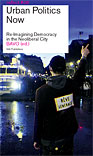
As the outcome of their research at the Jan van Eyck Academie, BAVO (Gideon Boie and Matthias Pauwels, researchers Theory 2004–2005) have edited two publications Cultural activism today. The art of over-identification (published by episode publishers) and Re-imagining democracy in the neoliberal city (published in the Reflect series of NAi Publishers).
On 1 October, a communal research project was started up by the Jan van Eyck Academie, Marres, NAi Maastricht, Academie Beeldende Kunsten and the Bonnefantenmuseum, about the area around the large Sphinx building in Maastricht and the urban development which is starting to be developed around there (the Belvédère project). Five researchers of the Jan van Eyck Academie, united in the Traces of Autism team, will carry out the research. more info
Karl-Hofer-Award 2007 for Romana Schmalisch
Romana Schmalisch (researcher Fine Art) has won the Karl-Hofer-Award 2007, the interdisciplinary award of the University of the Arts Berlin. Since 1979, this award has been presented annually on the occasion of the birthday of the painter and first post-war director of the university, Karl Hofer, in order to give artists and scientists an incentive and the opportunity to work out contributions to the manifold strained relations between arts and science and to the interrelationship between the art forms themselves. The motto of this year's competition was Existential Luxury.
Researchers are invited to submit proposals for the Panel for the American Comparative Literature Association 2008 Conference
(24-27 April 2008, Long Beach, California). The panel welcomes papers from a variety of disciplines that critically investigate the deployment of correspondence and letters as tools for 'reading into' literature, theory, and other bodies of work (art, religion, the law). Submission deadline: 15 November 2007. The panel is organized by Jillian Saint Jacques (researcher Theory). more info
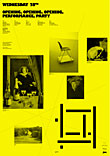
As part of research project The pensive image, advising researcher Hanneke Grootenboer edited the issue of Image[&]Narrative on 'Thinking pictures'. Now available online at: www.imageandnarrative.be. Among others with contributions by Jan van Eyck (ex) researchers: Anthony Auerbach, Nikolaus Gansterer, Sönke Hallmann, Benda Hofmeyr, Antony Hudek, Ils Huygens, Tom Van Imschoot and Charlotte Moth.
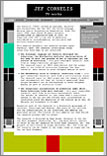
Website on Jef Cornelis TV Works
Now online: jefcornelis.janvaneyck.nl. This website documents the research project on the television work of Jef Cornelis, executor, director and scriptwriter for the VRT, the Dutch-language Belgian public broadcasting corporation. Besides an extensive biography, filmography and bibliography, the site publishes downloadable interviews with Cornelis, conducted by Koen Brams and Dirk Pültau. The interviews deal with specific films and subjects, such as Cornelis’ films on literature and major art events, his return to the visual arts, the relation between films and politics. In the near future, the site will be updated with the texts of the discursive programme of lectures and debates that took place with the framework of the project. All in all, the visitor of this website can follow the research process on Jef Cornelis and its output. Updates of the website will be announced in the Jan van Eyck newsletter.
The website is designed by Ingrid Stojnic (Researcher Design 2003-2005) of Rekall Design (www.rekalldesign.com). The research is led by Koen Brams, director of the Jan van Eyck Academie, and Dirk Pültau, editor-in-chief of art magazine De Witte Raaf. The project is facilitated by Argos (Brussels, BE). The films of Jef Cornelis can be viewed in the video rooms at Argos and the Jan van Eyck Academie.
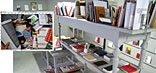
Salon für Kunstbuch
The Vienna-based Salon für Kunstbuch is presenting Dutch art books, including Jan van Eyck publications. For two years now the salon has been organising exhibitions, presentations and discursive programmes with publishers, artists, designers in the field of the art book, on a non-commercial basis. Its aim is to present contemporary art books, each time with a different focus. This time around, the emphasis is on Dutch publishers. more information: www.ostblick.at. All Jan van Eyck publications can also be ordered online.
Publication by Koen Brams and Dirk Pültau wins award
The publication Collectie Vlaamse Gemeenschap aanwinsten, written by Koen Brams and Dirk Pültau, has been granted the Plantin Moretus award for ‘Best Designed Book’ in Flanders, Belgium. The book was published by the Flemish Ministry for Culture and designed by Jurgen Persijn; it gives an overview of the acquisitions (1999-2001) of the Flemish Community, in texts and images. According to the jury, it is “a real inventory book which is attractive and has a user-friendly touch. (…) a treasure of design in honour of our artists.” In the essay ‘De mythologisering van de Belgische Kunst’ [the mythologization of Belgian art], Brams and Pultau analyse the genesis of the cliché concerning Belgian art, that is to say, the cliché that Belgian contemporary artists are all related to Ensor, Magritte and Broodthaers. The topics fleshing out this identity discours include, for instance, a biting or subversive irony, a particular sensitivity to the double layers of language and an inborn sense of independence.
Looking back: The roots of video production at the Jan van Eyck Academie
From the seventies onwards, the Jan van Eyck Academie has played a central role when it comes to applying new technologies to the context of fine art. It was one of the first institutes in the Netherlands where artists began to experiment with video. From the eighties onwards, these activities were structurally organised via the then ‘video workplace’. This year, the Jan van Eyck commissioned art historian Jennifer Steetskamp to research its rich history in video art production in relation to its video collection. The starting point of her project was a series of interviews with artists and facilitators active in and around the academy, including JCJ Vanderheyden, Servie Janssen, Madelon Hooykaas and Berto Ausseums (in chronological order). These interviews, together with the introductory text of Steetskamp, are now published.
Publishing in the arts. Expert meetings
The Jan van Eyck Academie has taken the initiative to organise a number of meetings with experts in the field of art and artist’s books in general, and, more particularly, of their distribution and marketing. The idea of the expert meetings is to come to an exchange of ideas in a small and informal setting that may stimulate and improve the situation of publishing in the arts. Each meeting is dedicated to a specific subject and case study.
At the first meeting (April 2007), Jan Voss of Boekie Woekie elaborated on the history, daily practice, ideals and ambitions of his twenty-year-old bookshop devoted to artists’ books. Boekie Woekie is a shaky business, he concludes, “it is about art, life and friendship. It is life itself…”. In the discussion which followed more practical aspects were tabled, including suggestions on how to be successful as a publisher or maker of artists’ books. Emphasis was paid to the presentation of books, the mediation between maker and buyer and general selling strategies. The text on Boekie Woekie and a report of the meeting including a list of practical tips are now published.
Participating experts were: Sarah Bodman (Research Fellow for Artist’s Books, Centre for Fine Print Research, University of West-England, Bristol), Johan Deumens (Artist’s Books, Heemstede), Wim Drijvers (Boekbeeld, Ghent), Jane Rolo (director and founder member of Book Works, London), Anne Thurmann-Jajes (head Study centre for artists books and Archive for Small Press & Communication, Bremen), Roger Willems (Roma Publications, Amsterdam).
Discussion Pedro Costa, Catherine David, Chris Dercon published online
During the Jan van Eyck Video Weekend (26–28 May 2007) a discussion was organized on the movement of video and film between cinema and the exhibition space. Taking up André Bazin’s question – ‘Qu’est-ce que le cinéma?’ – many find that today it is no longer relevant. Instead, we should ask the question ‘Where is cinema?’ Chris Dercon discusses with Catherine David, among other things, Passage de l’image, the exhibition David produced in 1998, one of the first exhibitions that really questioned the issue of cinema being exhibited – as opposed to the exhibition of cinema. It questioned the tension between the mobility and immobility of the image and the spectator and the tension that came with so many white rooms being darkened. The discussion takes up David’s presentation of Chantal Akerman’s installation D’Est, the presence of documentary film and video at Documenta X, and the presentation of the work of Pedro Costa in Witte de With. Pedro Costa considers his collaboration with David and his work as filmmaker. Having heard Catherine David and Pedro Costa we take up the initial question again and find that the question ‘Where is cinema?’ cannot be disconnected from the question ‘What is cinema?’ complete text
Interviews with Jef Cornelis published online
Two more interviews with Jef Cornelis conducted by Koen Brams and Dirk Pültau are published on the Jan van Eyck website.
The text ‘A reflexive attitude towards television: that’s very difficult’ deals with the films of Cornelis about literature. Though Cornelis was never part of the literary scene, he knew many writers, with some of whom he would collaborate on scripts. Cornelis produced films on Oscar de Wit, Jacq Vogelaar, Daniël Robberechts and Hans ten Berge. The interview deals with Cornelis’ interest in these writers, the case history and production of the films, the structure of the films in relation to the books and many more aspects.
The second interview ‘No question that television equals politics’, focuses on the television programme Container. Container was a talk show, first broadcast in 1989, featuring three to four intellectuals discussing a various range of subjects.
New researchers
This fall several designers and researchers will start their research periods at the Jan van Eyck.
David James Bennewith (researcher Design) is especially interested in the work of New Zealand type designer Joseph Churchward. Bennewith will question the biographical conventions of a typeface. He attempts to make the scope of Churchward’s material part of the larger context of graphic design and will research how practicing design can ‘give form’ to content, and can also serve as a reflection on itself.
Nina Støttrup Larsen (researcher Design) is fascinated by the experience she gets from an unexplored book, and how its form and content create a relation between the reader and the book. What makes a book so special compared to online publications? How can a book’s form affect the reading experience? How does a designer take responsibility for the extra layer of content that the form produces? Does the designer become an author?
Jayme Yen (researcher Design) is planning to read the city of Maastricht, get familiar with it and produce a book about it. Key questions in his research are: How does a person become familiar with a new city? How does one locate oneself in relation to unfamiliar environments? Do people maintain a kind of ‘ur-city’ in their heads, which helps them situate themselves in whatever city they visit? What kinds of knowledge appear first? What only appears after an extended stay? What information (or misinformation) changes over time? Can the book become a metaphor for a city? Apart from her Maastricht project Jayme Yen will be involved in the Traces of autism project.
Thomas Brockelman (researcher Theory) is finishing a book (Heidegger and Zizek: The Question Concerning Techno-Capitalism) on the work of Slavoj Zizek, a text which interprets his work as a response to Martin Heidegger. While in residence at the Jan van Eyck Academie, he will be researching Zizek’s debt to Jacques Lacan and considering the possibilities and limits of Zizek’s theory of revolution.
Jillian Saint Jacques (researcher Theory) is exploring an interdisciplinary theory of adaptation in the visual arts, literature, film and digital media. The theoretical lens for his project will take up, but not be limited to, poststructuralist theory (Butler, Bhabha, Silverman), psychoanalytic theory (Freud, Lacan, Miller), film theory (Deleuze, Mulvey, DeLauretis), emergence theory (Corning, Fromm) and linguistic theory (Bal, Barthes, Benveniste). Specifically, he will examine the ways in which theories and artistic works reflexively interact, overlap and readapt; the way in which Freud’s reading of Hoffman’s short story The Sandman becomes the basis for developing a psychoanalytic theory of the uncanny.
List of publications
All recent publications of the Jan van Eyck, including a backlist, are listed in a brochure. The presented publications are heterogeneous in form and kind. The academy does not state thematic or disciplinary guidelines nor does its publishing policy contain official recommendations with respect to content. Consequently, the books range from autonomous artists’ books, experimental publications in the field of design, theoretical volumes of essays, exhibition catalogues and magazines. The publications reflect what the Jan van Eyck Academie, post-academic institute for research and production, is all about. The list of publications is designed by Kasper Andreasen (ex-researcher Design) and can be ordered via bookshop@janvaneyck.nl. The publications are also listed at http://bookshop.janvaneyck.nl.

— book tickets with Anne Vangronsveld.
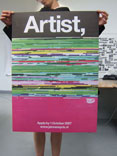
Call for applications Fine Art department
Artists, individuals as well as collaborative groups, are invited to apply for a research period at the Fine Art department of the Jan van Eyck. The research period, which will start in January 2008, can last up to two years. The Fine Art department offers a unique space for experimentation, production, reflection and debate. The researchers in the department conduct high-quality research in an environment that encourages the questioning of the assumptions, forms, meanings and contexts that are tied in with the practice of making art today. We welcome artists, individuals and groups, without stipulating conditions regarding form, content and media. more info
Yearbook 2006 online
The annual report 2006 is accessible online in Dutch (PDF 3.8MB) and English (PDF 4.7 MB). The book comprises texts of individual research projects of the (advising) researchers, collective research projects, as well as descriptions of productions realised last year (publications, exhibitions, conferences, ...) and institutional information. The basic concept of the book is a diary: it shows from day to day what happened at the Jan van Eyck in 2006. Similar to a daily newspaper, it is cold set rotation offset printed by the Media Groep Limburg. The book’s design is by the Tomorrow Book Studio, a Jan van Eyck design research team. The photographs of the studios are made by Jean-Baptiste Maitre (researcher Fine Art).
If you wish to receive a version in print of the Dutch or English book please send an email stating your coordinates to bookshop@janvaneyck.nl.
Collaboration Jan van Eyck Academie and Frans Masereel Centrum
The Jan van Eyck Academie and the Frans Masereel Centrum (Kasterlee, BE) have established an agreement of cooperation. The institutes will exchange know-how concerning the realisation of printing and graphics, editing, publishing and distributing and facilitating graphic productions. The institutes will also gear to each other as far as annual investment plans are concerned. Previously, the Jan van Eyck established a similar cooperation with FLACC (Genk, BE) to generate cross-border dynamics among residing artists/researchers. The Jan van Eyck Academie and FLACC aim at expanding the cooperation on a Euregional level.
Swiss Art Awards for Jan van Eyck artists
Raphaël Cuomo and Maria Iorio (researchers Fine Art) are laureates of the Swiss Art Award 2007. Their contributing film Sudeuropa, about mobility on the Sicilian island of Lampedusa and its surrounding area, focuses on two migratory movements: north-south — due to tourism — and south-north — due to (illegal) migration. Both phenomena are visible in the infrastructure of the island. On the one hand, there are touristy areas — holiday centres, for instance, with their functional architecture and seasonal occupation — that signify some kind of oriental exoticism. On the other, there are closed camps in which illegal immigrants are held and isolated upon arrival. The tourist economy, with the ‘help’ of the migration policies of Italy, Europe, Tunisia and Libya, has created a unilateral regime of visibility: migrants are kept out of sight lest they spoil the paradisiacal image of Lampedusa. In Sudeuropa (38 min.) Cuomo and Iorio show and criticise the power of images and the impact of cultural codes. The film was produced with the support of the Maghreb Connection, the Jan van Eyck Academie, FMAC Genève and Le souvenir du present.
Cuomo and Iorio were selected among 604 contenders. Former researcher Robert Estermann (researcher Fine Art 1999–2001) was also laureate of the Swiss Art Award 2007. In his drawings and photographs Estermann investigates social phenomena and the issue of difference within cultural traditions. Estermann takes a performative approach, makes installations, and transfers his subject matter to spatial structures that challenge the viewer directly and physically. more info
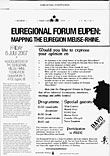
Call for papers: S
S is the new open-access journal of the Jan van Eyck Circle for Lacanian ideology Critique. S publishes peer-reviewed essays on Lacanian and related topics from the fields of art, film and literary criticism, political, philosophical and ideological critique. With permission, S also re-publishes hard-to-obtain essays and translations from seminal thinkers in Lacanian studies, whose work deserves the worldwide dissemination that free online publishing affords.
The inaugural issue, S1, will present texts that deal with the Imaginary in the Lacanian sense of the word, as well as essays from the broader field of (psychoanalysis and) aesthetics. Topics include: the return of the Imaginary in the later Lacan; lesser-known writers in Lacan’s work (i.e. other than Sophocles, Shakespeare, Claudel, Gide and Joyce): Blanchot, Bataille, Plautus, etc.; the unconditioned Name of the Father; beauty beyond the phallus; spaces of conceptual and linguistic impossibility: topology and tropology; aesthetics and ethics are one? (Wittgenstein); the scansion of interpretation (Milner); the gaze, the look and the ‘other eye’: the tableau in Lacan and Foucault; the site or non-site of the Imaginary in Badiou; politics and aesthetics (Rancière, Balibar, Adorno, others).
Submissions in MLA format can be sent before 30 June to lineofbeauty@telenet.be.
Two interviews with Jef Cornelis published
In the framework of the research project on the television work of Jef Cornelis, two interviews, held by Koen Brams and Dirk Pültau, have been published - in English. They focus on the content of several films as well as on the historical and technical settings in which these were produced.
The first interview emphasizes Cornelis’ projects on architecture and urban planning. The film Mens en agglomeratie (1966) is about the new ideal city, taking Dubrovnik and Stockholm as examples. Waarover men niet spreekt (1968) also deals with the state of urban planning in Europe and a number of urban planning situations in Italy, Switzerland and the Netherlands. Besides it discusses illusions about individual housing. De straat (1972), however, does not talk “about what had been built, but about what had not – the empty tube formed by the street”. The film is about the non-physical public domain, with an emphasis on the impact of motor traffic on urban planning. The interview is available. The interview previously was published in Dutch and English in Open/Cahier over kunst en het publieke domein, nr. 11, 2006.
The second interview ‘I was too curious to hand everything over to the artists’, deals with the film Sonsbeek buiten de perken (1971) and other films on major art events. Although “there really wasn’t very much to see at Sonsbeek” – the pieces looked lost and the exhibition fell apart –, Cornelis states that he “tried to reproduce the events, as far as they were discernable, in a detached manner”. He sees the film as a commentary, a report that fairly accurately reflects what was happening there. The interview is available. The interview previously was published in Dutch (with an English summary) in Jong Holland, volume 22, number 3, 2006.
Karolin Meunier (researcher Fine Art 2007–2008) recently published the article ‘The act of responding. The letter as a form of communication’ in Ik ben Artis, a publication by the artist’s initiative Artis. In this text Meunier elaborates on different aspects of the letter: the fear of failing to reach the other, the failure of writing, the hope that the reading implies an understanding, the hope that its meaning is conveyed. Referring to the correspondence between Franz Kafka and Milena Jesenskás and the political dimension of visualizing the human face by Giorgio Agamben, Meunier concludes that the structure of a letter is “essential to any form of communication, if the other is understood in relative absence of oneself”.

— screenings, presentations, discussions with among others Chantal Akerman, Cel Crabeels, Robrecht Vanderbeeken, Johan Grimonprez, Mark Nash, Pedro Costa, Catherine David, Chris Dercon, Corinne Castel, Dirk de Wit, Pavel Braila, Knut Asdam, Rein Wolfs, Jennifer Steetskamp, Isa Rosenberger
The website of the Jan van Eyck Circle for Lacanian ideology Critique is renewed. Its new design offers clear information on all current and past CLiC events. The site is made by Rekall Design, Bert Balcaen and Ingrid Stojinic (researchers Design 2003–2005).
Robrecht Vanderbeeken (researcher Theory 2004–2005) edited the proceedings of the symposium Kritische Metafysica: Gilles Deleuze (29 May 2006). The publication also contains articles by Marc De Kesel and Dominiek Hoens, former and current advising researcher of the Jan van Eyck Circle for Lacanian ideology Critique. more
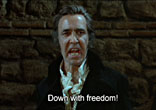
The phantom of liberty: psychoanalysis as a philosophy of freedom?
— conference organized by Aaron Schuster with
Ed Pluth, Mladen Dolar, Lorenzo Chiesa, Marc De Kesel, Russell Grigg
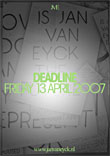
Call for applications: deadline Friday 13 April 2007
Artists, designers and theoreticians are invited to submit research and production proposals to become a researcher at the Jan van Eyck Academie. Candidates can either apply with a topic of their own or for a collective project formulated by the institute itself. Candidates can apply for a one-year, two-year or variable research period, starting 1 January 2008.
Collective research project to which candidates can apply are:
– Logo Parc. Challenging the aesthetics of economy
– Traces of autism. Wander-research in the Euregion Meuse-Rhine
– After 1968. What is the political?
– Circle for Lacanian ideology Critique
more info or contact: leon.westenberg@janvaneyck.nl
Mathematicians, chemists, other scientists, legal experts, sound artists, theatre producers or cultural producers are welcome to apply to the research project Traces of autism. This project concerns the making of an inventory of public space in the Euregion Meuse-Rhine, based on journeys made through the area and following a number of strict parameters. The current team consists of two public space designers, one architect and one cultural theorist. To complete the team, candidates from different disciplines and backgrounds are invited to submit a proposal. Application deadline: Friday 13 April 2007. more info
Logo Parc presents ts research at the conference Playing the urban
Listening to the Archive I: mémoires de sourd. A workshop around 'Les immatériaux'
— workshop organised by Antony Hudek
— conference at Stedelijk Museum CS, Amsterdam, NL
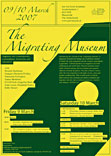
— conference
Over the last months, the Jan van Eyck Academie (Maastricht) and FLACC have been working together in the area of research and the support of projects developed within the programmes of both institutes. Henceforth, their workshop facilities and technical expertise will be used collectively for the realisation of productions. Moreover, the Jan van Eyck Academie offers free access to the library and the documentation centre. The institutes have drawn up a communal inventory of all facilities and know-how present and will exchange annual facilitary investment plans. The institutions are also working on a communal database of external expertise useful in the realisation of productions. FLACC and the Jan van Eyck Academie intend to be complementary vis-à-vis facilities and expertise as well as create a cross-border dynamics of residing artists/researchers. Both institutes want this collaboration to be extended, preferably at a Euregional level.
More information on FLACC
Bruno Besana (current researcher Theory) and Oliver Feltham (researcher Theory 2005) edited the book Ecrits autour de la pensée d’Alain Badiou, published recently by LHarmattan (Paris).
Multiplicity, event, situation. Crossing these three concepts in a strongly articulated system, Alain Badiou shows how an identity (an object, a human being or a work of art) is not defined by an inner principle or an essence, but is rather the gathering of an infinity of elements; and an event is then exactly the turning point of a given situation, in which a new principle of construction renders possible the rising of some radically new identities.
This book tries to size up the articulations of this system, it tries to size up the points in which such thought is shaped, with the help of some extra-philosophical materials (mathematics for the thought of being; art, psychoanalysis and politics for the thought of the event). In other words, it tries to question the genetic point of a philosophical system on its border. Borders whose center is engendered, borders enabling us to see the interference of some new elements and thus think the unthought of our present situation.
The book displays articles from four present and former Jan van Eyck Academie Theory researchers. Oliver Feltham couples the concept of “unthought of a situation” with the Aboriginal Australian movement; Dominiek Hoens (advising researcher Theory) investigates the senses of the word ‘love’ as sized up in the confrontation with Lacanian psychoanalysis; Barbara Formis puts back-to-back Duchamp’s idea of ready-made and Badiou’s concept of event; and Bruno Besana links Deleuze’s and Badiou’s concepts of multiplicity via their crossed readings of Plato’s idea of the relation between the one and the many.
The book can be borrowed from the Jan van Eyck library.
Jan van Eyck Bookshop online
This month the Jan van Eyck Bookshop went online. All publications made by our artists, designers and theoreticians can now be browsed easily (by date, title and name), and ordered on-line. Those who would first want to view a book in reality can visit one of the bookshops listed on the site.
The Jan van Eyck publications on offer are quite heterogeneous in nature. The academy does not have an editorial board dictating thematic or disciplinary guidelines to establish a publisher’s list, nor does its publishing policy contain official recommendations about content. Consequently, our online bookshop contains autonomous artists’ books, experimental publications in the field of design, theoretical volumes of essays, exhibition catalogues and magazines. The publications have either been initiated by the (advising) researchers – artists, designers and theoreticians – or by the institute itself. The Jan van Eyck also handles the production and distribution of its books.

New research project: Quaero: Searching for searching
On the initiative of Meta Haven: Design Research, the Design department is starting a new research project this month. This brief project, running to September 2007, will investigate the French search engine Quaero. The project aims to merge design research with a discussion on internet, politics, public domain and cultural heritage. Moreover, it will attempt to outline some possible features for Quaero’s identity, emphasising its being a distinctly public medium which simultaneously transgresses the culture of the grand projet into the digital realm. The programme will involve at least one public conference and one research conference. Results will be published in the 2007 book Uncorporate identity.
The project is guided by advising researchers Daniël van der Velden, Vinca Kruk
Researchers are Tsila Hassine, Gon Zifroni
The Logo of Bucharest
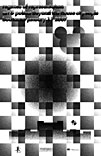
On 11 January the symposium Regimes of representation. Art and Politics beyond the House of People took place at the Palatul Parlamentului in Bucharest, organised by Meta Haven: Design Research (Vinca Kruk and Daniël van der Velden). The conference wanted to present various ideas on art, power and politics, as a direct response to the House of People and its use. During one day of lectures and discussions, Chantal Mouffe, Nicolas Bourriaud, Jonathan Dronsfield, Marcus Steinweg and the collective 4Space considered the relationship between power and architecture, the museum and politics.
In their online diaries the organisers reflect on the meaning of the House of People, having been warned that the subject of the conference was a sensitive issue for the national museum for contemporary art (MNAC) housed in the House of People. After all, the discussion about this institute, its political embedment, its name and its location, which had raged from the moment of its inception, could flare up again at any moment. Kruk and Van der Velden doubt whether the rhetorical methods used to change the House of People from a perverse symbol of power into an acceptable ‘democratic’ building actually work. “Nobody who claps eyes on the palace sees a valuable gem symbolising democracy. The fact is that an extraordinarily powerful symbol has been created. The question is: what does it mean?”
The diary can be viewed on: http://www.archined.nl.
The Romanian paper Observator cultural introduced the topic of the conference and voiced some reflections by Ruxandra Balaci and Ciprina Mihali. The event was also announced in national newspaper Romania libera.
more info (in Dutch)
The Jan van Eyck is recruiting a webmaster and coordinator of on-line and off-line productions, and a financial an administrative employee. more info (in Dutch)
— exhibition
— STUK, Leuven, BE; Artis, Den Bosch, NL
— symposium organized by Meta Haven; with Vinca Kruk, Chantal Mouffe, Nicolas Bourriaud, Jonathan Dronsfield, Marcus Steinweg, 4Space (Augustin Ioan & Ciprian Mihali)
— MNAC, Bucharest, RO
New advising researchers: Imogen Stidworthy, Katja Diefenbach, Dominiek Hoens
This month fine artist Imogen Stidworthy and theoreticians Katja Diefenbach and Dominiek Hoens take up their new functions as advising researchers in the Jan van Eyck Academie.
New researchers
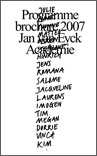
In the new academic year, starting this January, 21 researchers begin their research period at the Jan van Eyck. Their project plans and CVs are published on this website (button researchers) and in the Jan van Eyck programme brochure designed by Matthijs van Leeuwen. We welcome the following eight artists, five designers and eight theoreticians:
Fine Art researchers: Thibaut Jacquerie (BE), Rachel Koolen (NL), Ines Lechleitner (AT), Jean-Baptiste Maitre (FR), Kobe Matthys (BE), Karolin Meunier (DE), Peter Müller (DE), Stephane Querrec (FR). Design researchers: Eva Moulaert (BE), Julie Peeters (BE), Jens Schildt (SE), Salome Schmuki (CH), Raoul Wassenaar (NL). Theory researchers: Anthony Auerbach (GB), Bruno Besana (IT), Jan Hein Hoogstad (NL), Sigi Jöttkandt (AU), Roland Meyer (DE), Ozren Pupovac (YU), Marina Vishmidt (UA), Tanja Widmann (AT).
Thinking through affect
On 8 and 9 September 2006 the symposium Thinking through affect took place in the Jan van Eyck Academie. The research project bearing the same title assumes an intrinsic link between image, affect, movement and emotion. The symposium intended to bring together theoreticians who have worked along similar conceptual lines to develop thinking about affect and formulate a conceptual framework to do so. Many of the lectures dealt with these connections from various perspectives. The lectures did not exclusively focus on film and media theory; interesting references were made to gender theory, theatre and dance studies as well as the fields of the visual arts, philosophy and aesthetics. Thinking through affect was organized by Ils Huygens (researcher Theory 2005–2006). A report of the symposium is now published.
Thinking through the body
On 4 November 2006, the workshop Thinking through the body took place at the Jan van Eyck Academie. Thinking through the body was an international encounter between philosophers, art critics, artists and body practitioners. Six guests were invited: Richard Shusterman, Jacinto Lageira, Erica Ando, Agnès Lontrade, Aline Caillet and Emmanuel Alloa. Thinking through the body was an initiative of Barbara Formis (researcher Theory 2006). The main purpose of the day was to investigate new ways of dealing with the body, either as a living experience or as an aesthetical concept. The workshop consisted of three presentations (each followed by a response) and a Feldenkrais technique workshop. A report of the workshop is now published.
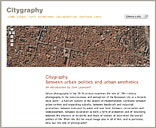
Citygraphy. Between Urban Politics and Urban Aesthetics
Recently, the research contents of the Citygraphy project were published on a special project website: www.citygraphy.com. Citygraphy examines the role of 19th-century photography in the consciousness and perception of the European city as a historic focal point – a fulcrum subject to the powers of modernization. Contrasts between urban centres and expanding suburbs, between handicraft and industrial production, between transport by water and over land, between conservation and redevelopment, between restoration as a form of protection and of rebuilding, between the interests of residents and those of visitors all determine the overall politics of life. What role did the visual image play in all of this, and in particular, what was the role of photography?
To date, the following cities have been under investigation: Bruges (BE), Bologna (IT) and Maastricht (NL). The research has been essentially interdisciplinary. It is about reconstructing the context within which the images were made. It is self-evident that local politics, social conditions, restoration policies, architectural concepts, the rise of tourism, 'print culture', the history of photography as a technique, its practice and its exploitation all play a part. Citygraphy takes the role of photography as a fully-fledged cultural component seriously. Its visual statements about cities and architecture, their history and relevance deserve the same attention as do contemporary prints or paintings of urban landscapes, or 19th-century novels in which the city is so often depicted as both décor and protagonist. The paradoxical essence of the new versus the old city was the cornerstone of a major part of 19th-century culture; it was questioned in novels, poetry and paintings. Photography must also have been sensitive to this atmosphere. What forms did photography take in order to play an active role in the overall picture? Are these forms aesthetically identifiable? In photography, the intentions of the content cannot be separated from aesthetic objectives. Insight into the aesthetics of these images is as important as insight into their politics.
The website comprises articles and an extensive image database. Artistic coordinator of Citygraphy is Dirk Lauwaert, Jan van Eyck researcher is Lilo Bauer.
In March and April, Dirk Lauwaert will present the lecture series Namiddagen van de topografie in the Beursschouwburg in Brussels. On Friday 9 March the photographical and literary representation of New York is being discussed by Lilo Bauer (researcher Citygraphy), Steven Humlet, Bart Eeckhout and Yves Schoonjans. The following Friday, 16 March, Fredie Floré, Ad De Jong and Andrea Stultiens will concentrate on open air villages, museological interiors and model houses. Subsequently, Marjolijn Dijkman (researcher Fine Art), Martijn Hendriks and Maarten Vanden Eynde will elaborate on the remapping of Los Angeles, on Friday 23 March. Then, on Friday 30 March, Simon Ditchfield and Luc Duerloo will talk about rituals, history and topography in the religious world view of the early modern period. More info: www.beursschouwburg.be.
Interview Astrid Wege
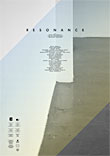
On behalf of the Jan van Eyck Academie, Astrid Wege was interviewed about her curation of the exhibition Resonance: how one reality can be understood through another. The exhibition was held in two spaces: Artis in ‘s-Hertogenbosch and STUK in Leuven, featuring works by all Fine Art researchers at the Jan van Eyck Academie in 2006, as well as a number of former researchers from the past seven years. Interviewer Antony Hudek (researcher Theory department) had the transcript published as part of MOCA MAAS’s (Museum of Contemporary Art, Maastricht www.mocamaas.org) contribution to Groothertogdom Brabant – a two-week project beginning on 13 January 2007, which brings together regional Belgian and Dutch artists’ initiatives under one roof at the Van Abbemuseum in Eindhoven. By publicizing issues raised specifically by Resonance – such as the curatorial challenges posed by a predetermined set of artists; the possibility of conceiving a ‘critical’ exhibition; the institution’s role in commissioning such an exhibition – in a museum occupied by art organisations, the interview re-performs Astrid Wege’s reflection on the transference between institutional spaces. Moreover, as the interview transcends from commissioned piece by and for one institution (Jan van Eyck Academie) to a text reclaimed by a self-displacing organism (MOCA MAAS) for an established museum (Van Abbemuseum), the dangers of excessive resonance are brought into relief: in whose names – either institutional or personal – are the different actors in this expanding dialogue speaking? And how many orders of space enter here in (potential contra)diction, between the regional and the national, the ‘alternative’ and the institutional, the historical and the symbolic/mythical? These and other questions will structure the round-table discussion organised by MOCA MAAS at the Van Abbemuseum on 21 January 2007.
To receive the monthly Jan van Eyck newsletter by email including the upcoming events, please mail to: brief@janvaneyck.nl, subject heading 'subscribe'.